Tommy’s conflict with his future stepfather Staffan
Let the Right One InTommy’s conflict with his future stepfather Staffan is shaped by a tension between protection and authority: Staffan shields Tommy from the consequences of vandalizing a church artifact, then tries to reach him as a parent figure, but eventually approaches him as a police officer and finds him amid a disturbing scene. Their relationship remains unsettled between these encounters. Tommy does not simply accept Staffan’s protection, and Staffan’s efforts to understand him are repeatedly compromised by secrecy, anger, and assumptions about the boy’s conduct.
A secret protected
Tommy’s vandalism of a christening font is the first clear test of the relationship. The font has acquired a black crust, and the minister is distressed; it is an antique that must be sent away for restoration. Yvonne explains that Staffan did not tell the minister Tommy was responsible. Instead, he lied to protect him, despite finding it difficult to deceive someone in light of his faith. The concealment offers Tommy practical protection, but it also creates a debt and a secret between the boy and the man who is to become part of his family.
Tommy recognizes the awkwardness of Staffan’s position. He is not Staffan’s stepson in the formal sense, though he calls Staffan his sort-of stepfather, and he imagines that Staffan would not want the minister to hear that the culprit was his prospective stepson. His reluctance to come forward is therefore bound up with how the relationship might look to other people, not merely with the damage itself. Yvonne urges him to speak to Staffan directly. Tommy declines for the moment, and she identifies his hesitation as fear. The exchange leaves the essential conversation postponed: Staffan has protected him, but Tommy has not yet answered that gesture with a direct admission.
An attempted conversation, under strain
Staffan and Yvonne’s household is not presented as an uncomplicated refuge for Tommy. At one point Staffan says that he feels an intense desire to hit Yvonne and asks her to stop speaking. His pinched lips, scalded hand, and gesture that evokes peace sit beside his explicitly voiced anger. Yvonne has already sensed that rage exists behind his pious appearance, although she has not admitted that perception even to herself. This moment concerns Staffan and Yvonne directly, but it gives context to the difficult atmosphere around Tommy’s place in their household: the prospective stepfather’s benevolent intentions coexist with anger that is not easily contained.
Staffan nevertheless decides that he and Yvonne should contact Robban and ask Tommy to come home so that Staffan can talk with him. The plan signals a move toward direct engagement rather than leaving the christening-font incident as an unspoken favor. Yet the attempt remains indirect: Staffan wants Tommy brought home for a conversation, and Yvonne is involved in arranging it. When Staffan asks where Tommy is, he learns that Yvonne has promised not to tell him. She specifies that her promise concerns Tommy’s location. Staffan says he no longer understands what is happening, exposing a gap between his desire to speak to the boy and the trust Tommy has placed elsewhere. Protection has not produced openness; instead, the adults’ promises and Tommy’s whereabouts keep the conversation out of reach.
The guardian and the officer
On a Monday, Staffan gets up at eight, before Tommy’s school begins at a quarter to nine, intending to have a man-to-man talk with him. He is also due to report for duty at nine in Judarn to continue a forest search that he expects will prove fruitless. The competing obligations place his attempt to meet Tommy within his police routine. He considers going down in ordinary clothes and speaking like an ordinary person, but reasons that the matter is vandalism and puts on his uniform. He recognizes that the uniform gives him a shell of authority. The choice makes the relationship’s central difficulty concrete: he wants a personal conversation, yet approaches Tommy through the power and formality of his profession.
Before seeing him, Staffan reads a piece of paper and concludes that Tommy must be responsible for tampering with a storage-unit lock. The explanation he settles on is a burglar’s trick: someone makes an excuse to visit a place, interferes with the lock, and hopes the owner will not notice. Staffan does not consider why Tommy would need to rig a lock on a door for which he already has a key. Instead, he casts Tommy as a thief who hangs around the place. Yvonne has described the location of Tommy’s unit, and Staffan walks there preparing a lecture about juvenile detention, social services, and the age at which someone can be tried as an adult. He has considered taking a friendly approach, but the lock has made him angry again. His planned talk is meant to explain consequences rather than threaten Tommy, yet it rests on a confident conclusion that the evidence does not establish.
Discovery and rupture
The storage-unit door is open. Inside, Staffan finds signs of blood on the floor and on Tommy’s blanket, and backs out, alarmed. The discovery abruptly displaces the lecture he had prepared. Staffan’s assumption that Tommy has committed a burglary-related offense gives way to a situation far more serious than the one he expected, and his role as a concerned future stepfather becomes inseparable from his response as a police officer.
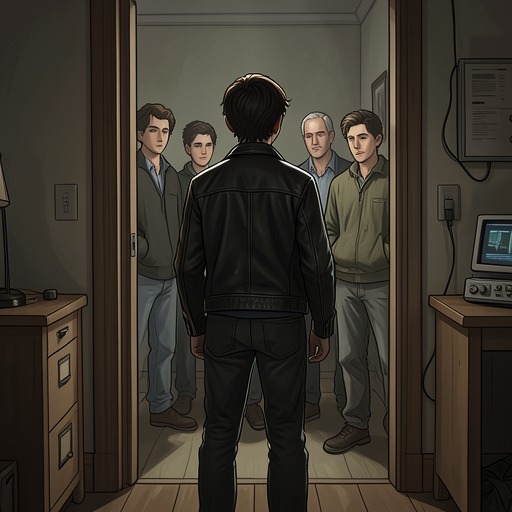
When Staffan pushes another door open with his baton, he sees Tommy kneeling beside badly damaged remains. Tommy holds a square stone in both hands and brings it down as part of a repeated action while singing. The scene is the sharpest reversal in their relationship’s documented course: Staffan had set out to correct what he believed was Tommy’s delinquency, but instead encounters the boy in circumstances he had not imagined. The evidence establishes the shock of discovery, not what Staffan does afterward or how Tommy explains himself. Their relationship is left at that threshold, with Staffan’s wish to talk overtaken by an encounter that neither his earlier protection nor his prepared lecture could contain.